Showing posts with label Technology and Internet. Show all posts

Wednesday, 14 March 2012

Pi Day: A Celebration From Talk Nerdy To Me! (VIDEO)


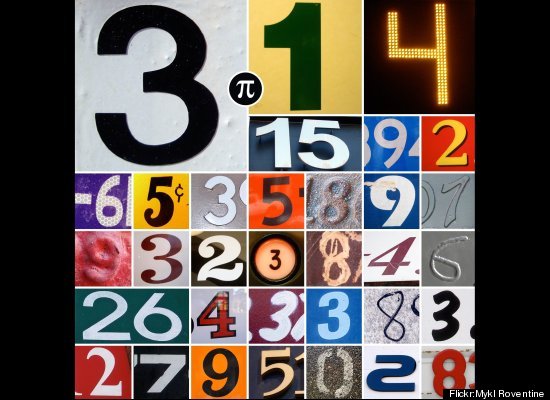
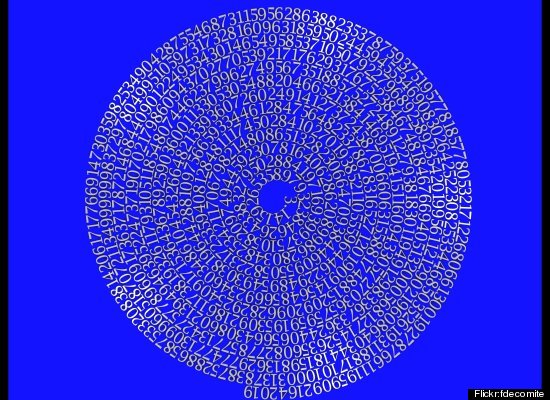
Today is March 14, also known as 3.14, also known as Pi Day. Geeks around the world will unite today to celebrate one of the most fascinating and beautiful constants in all of mathematics.

I've made a video to celebrate this special day with each and every one of you! So please take a moment to watch, share, and raise a glass to pi!

Also, see the full music video or download the MP3 for Hard 'N Phirm's song Pi, which happens to have a running time of 3:14 and was graciously provided for use in the video above. Happy Pi Day, everyone!


Saturday, 10 March 2012

Full Titanic wreck site is mapped for first time


Images of sunken Titanic released for first time

 A comprehensive map of the debris field surrounding the bow and stern of the Titanic on the bottom of the North Atlantic Ocean was released for the first time, Friday. The luxury passenger liner sank about 375 miles south of Newfoundland, Canada, after striking an iceberg on its maiden voyage from England to New York on April 15, 1912, killing 1,517 people

This composite image, released by RMS Titanic Inc., and made from sonar and more than 100,000 photos taken in 2010 from by unmanned, underwater robots, shows a small portion of a comprehensive map of the 3-by-5-mile debris field surrounding the bow of the Titanic on the bottom of the North Atlantic Ocean. The luxury passenger liner sank about 375 miles south of Newfoundland, Canada, after striking an iceberg on its maiden voyage from England to New York on April 15, 1912, killing more than 1,500 people. (AP Photo/RMS Titanic Inc.)
Source: AP2011


Wednesday, 7 March 2012

Solar Flares Unleashed By Sun On March 6 Include Strongest This Year

By: Tariq Malik
Published: 03/07/2012 07:31 AM EST on SPACE.com

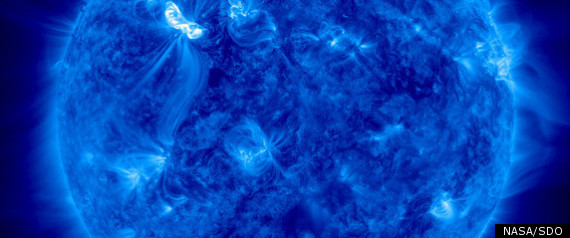
The sun unleashed a cosmic double whammy Tuesday (March 6), erupting with two major flares to cap a busy day of powerful solar storms. One of the flares is the most powerful solar eruption of the year, so far.
Both of the huge flares ranked as X-class storms, the strongest type of solar flares the sun can have.

 They followed several weaker, but still powerful, sun storms on Tuesday and came just days after another major solar flare on Sunday night.

The first big solar storm was also the most powerful one, ranking as an X5.4-class flare after erupting at 7:02 p.m. EST (0002 March 7 GMT), according to an alert from the Space Weather Prediction Center operated by the National Weather Service. It is the strongest solar flare yet for 2012.

The second event occurred just over an hour later, reaching a maximum strength of X1.3.


y Phillips wrote on his website Spaceweather.com, which monitors space weather events. "Our best guess is 'probably, yes, but not directly toward Earth.' A glancing blow to our planet's magnetosphere is possible on March 8th or 9th." [Worst Solar Storms in History]

According to Phillips, the big X5.4 solar flare erupted from the giant active sunspot AR1429, which was also responsible for the major sun storm on Sunday.


When aimed directly at Earth, X-class solar flares can endanger astronauts and satellites in orbit, interfere with satellite communications and damage power grids on Earth. They can also amplify the Earth's display of northern and southern lights, also known as auroras.

 Charged particles from the solar storms can interact with Earth's upper atmosphere, resulting in a glow that is typically visible to observers at high northern or southern latitudes.

Astronomers rank solar flares by strength using five categories: A, B, C, M and X. The A-class flares are the weakest sun storms, while the X-class events are the most powerful solar flares.

This ranking system was designed by the National Oceanic and Atmospheric Administration and resembles the Richter scale used for earthquakes in that each category is 10 times stronger than the one before it, NASA officials have said. So a B-class solar flare is 10 times stronger than an A-class event, while a C-class solar storm releases 10 times more energy than B-class flare (or 100 times more energy than an A-class event).

The categories are also broken down into subsets, from 1 to 9, to pinpoint a solar flare's strength. Only X-class solar flares have subcategories that go higher than 9. The most powerful solar flare on record occurred in 2003 and was estimated to be an X28 on the solar flare scale, NASA officials said.

Tuesday's X-class solar flares followed a string of other eruptions that included M-class and C-class events, space weather officials said. Both of the day's X-class sun storms were stronger than the X1.1 solar flare of March 5.

Prior to this week, the only huge solar flare of 2012 occurred on Jan. 27, when the sun unleashed an X1.7-class eruption.

The sun is currently going through an active phase of its 11-year weather cycle. The current cycle is known as Solar Cycle 24 and is expected to reach its peak level of activity in 2013, NASA officials have said.

Sunday, 4 March 2012

Asteroid 2011 AG5 May Pose Threat to Earth in 2040


Scientists are keeping a close eye on a big asteroid that may pose an impact threat to Earth in a few decades.
The space rock, which is called 2011 AG5, is about 460 feet (140 meters) wide. It may come close enough to Earth in 2040 that some researchers are calling for a discussion about how to deflect it.
Talk about the asteroid was on the agenda during the 49th session of the Scientific and Technical Subcommittee of the United Nations Committee on the Peaceful Uses of Outer Space (COPUOS), held earlier this month in Vienna.
A UN Action Team on near-Earth objects (NEOs) noted the asteroid’s repeat approaches to Earth and the possibility — however remote — that 2011 AG5 might smack into our planet 28 years from now.
The object was discovered in January 2011 by Mount Lemmon Survey observers in Tucson, Ariz. While scientists have a good bead on the space rock's size, its mass and compositional makeup are unknown at present. [The 7 Strangest Asteroids in the Solar System]
An asteroid desktop exercise
"2011 AG5 is the object which currently has the highest chance of impacting the Earth … in 2040. However, we have only observed it for about half an orbit, thus the confidence in these calculations is still not very high," said Detlef Koschny of the European Space Agency’s Solar System Missions Division in Noordwijk, The Netherlands.


Sunday, 29 January 2012

Google Ad Preferences Thinks It Knows Who You Are, What You Search


Here's a fun one.

There's an option in your Google account that displays your Ad Preferences page, which lets you see who Google thinks you are and what you're interested in.

If you're an avid Googler, then you probably use the search engine many times a day to find for driving direction, movie times, stock tips, local weather, cooking recipes, sweet deals on shoes and more. Based on what you've searched, Google makes inferences about your demographics and uses this information to show you relevant ads as you use Google products online.
[CORRECTION: A Google rep has pointed out that this feature reflects only the sites you've visited that are a part of Google's ad network and doesn't necessarily represent your complete Google search history.]
The search engine says that I'm interested in the following general categories: Arts & Entertainment, Computers & Electronics, Internet & Telecom, Law & Government, Science. Based on these "interests," Google has inferred that I'm a male, aged 35 - 44.

In real life, I'm actually a 25-year-old female. Way to go, Google.

Want to find out who Google thinks you are? Click here to view your Google Ad Preferences page. You should sign into your Google account (via Gmail, Google+ or another Google service) if you aren't already.

You should see a page that looks like this:


You can opt out of these Ad Preferences by clicking "edit or remove" under the Interests section and under the Demographics section.

Even if Google has your demographics totally wrong, privacy advocates are wary of the level of intimacy the web giant and many other online services collect about their users.
"Consumers have increasingly digital lives and they are developing an unfathomably large data trail every day," Rainey Reitman, activism director for privacy group Electronic Frontier Foundation, told the Daily Mail on Friday. "There has never been another time in history where privacy was under the kind of assault it is today."

Contrary to some reports, Google did not open the Ad Preferences page as a result of recent controversial modifications to its privacy policy. Ad Preferences have been viewable by users since 2009, according to a Google rep. The feature was expanded last October to give the user a more detailed view of his or her preferences. "The feature is designed to allay consumer concerns about tracking and targeting," Search Engine Land wrote at the time. "For advertisers, the new options will presumably provide more transparency and trust, and also ensure that marketers don’t bother to deliver ads to those who are actively negative about them."