Showing posts with label Politics. Show all posts

Wednesday, 21 March 2012

Mitt Romney's Illinois Primary Win Another Missed Opportunity For Rick Santorum


SCHAUMBURG, Ill. -- The "act of God" that Mitt Romney's campaign says Rick Santorum needs to win the Republican nomination is moving from healing status to that of resurrecting the dead.

Romney won the Illinois Republican primary Tuesday night, claiming a majority of the state's 69 delegates and moving closer to his party's nomination.

Romney's victory was another setback -- and huge missed opportunity -- for Santorum, a former senator from Pennsylvania who has repeatedly been unable to defeat Romney in large industrial Northern states with big urban centers.

Romney, the former Massachusetts governor, turned Santorum back in Michigan and Ohio over the past month. And in Illinois, Romney did it again. Romney led Santorum 46.7 percent to 35 percent, with 99 percent of the vote counted.

 The Associated Press count of delegates won gave Romney 43 and Santorum 10, with one delegate up in the air -- a stinging loss for Santorum.

Romney's win kept Santorum away from a major win after the former senator's surprise victories in Mississippi and Alabama a week ago.

As he has throughout the entire primary fight, Romney enjoyed a massive advertising advantage. Santorum and a super PAC supporting him, The Red White And Blue Fund, were outspent by Romney and the pro-Romney super PAC, Restore Our Future, by about $3.7 million to roughly $530,000, according to Politico.

Santorum's inability to win a major showdown in Northern states has previously been a momentum-stopper. His Illinois loss may be more than that.

He continues to lag behind Romney in delegates. But more importantly, the potential for him to catch fire as the unquestioned conservative alternative to Romney -- with the full support of the GOP's grassroots -- seems to be slipping out of reach.

Although Illinois would have been a tough state for Santorum no matter what, his failure to capitalize on the wins in Mississippi and Alabama was due to his own lack of message discipline.

 It has now become an established pattern for Santorum to shoot himself in the foot in the days leading up to a big primary contest.

In the days following his Southern wins, Santorum made waves with comments about the Obama administration's lack of enforcement of laws concerning pornography. And then Monday, he made two gaffes regarding the economy.

"The issue in this race is not the economy," Santorum said in Rockford Monday morning.

Then in Moline, Santorum said, "I don't care what the unemployment rate is going to be. It doesn't matter to me.

 My campaign doesn't hinge on unemployment rates and growth rates. There's something more foundational that's going on here."

Romney put an exclamation mark on his night by giving one of the stronger speeches of his candidacy, expanding on the theme of "economic freedom" that he spoke about Monday.

"So tonight is a primary, but November is a general election, and we're going to face a defining decision as a people.

 Our choice will not be about party or even personality. This election will be about principle. Our economic freedom will be on the ballot," Romney said.

Romney accused President Barack Obama of waging "an all-out assault on our freedom" through government intrusion into the public sector, environmental restrictions, and other government regulations.

But there were still red flags for the former Massachusetts governor. Exit polls showed that about 53 percent of those who voted for Romney said they had "reservations" about their candidate.

As for Santorum, his campaign aides argued Tuesday that they are not trailing Romney in the race for 1,144 delegates by as much as most estimates by media outlets -- and the Romney campaign -– say. The 1,144 mark is the number of delegates needed to clinch the nomination.

The Associated Press estimate of delegates, for example, gives Romney 522 to Santorum's 253 at this point. But the Santorum campaign has taken issue with those numbers, arguing that their count has Romney at 435 and Santorum at 311.

"Romney's treating it as a foregone conclusion, and he's putting delegates in his count that aren't theirs, he's taking delegates away from other people that he can't take away," said Santorum's spokesman, Hogan Gidley, on an hour-long conference call with reporters.

The Santorum argument is that many of the caucus states that have voted so far, including Iowa, Minnesota, Colorado, Missouri and Washington, have rules that mean their delegates are awarded based on which campaign can get the most supporters to the state convention. Convention attendees vote on delegates to the national convention.

Santorum's delegate counter, John Yob, said that the campaign and that of Ron Paul are showing strength in the process of pushing their people through the state convention process.

 But when asked to provide a list, for example, of which state convention delegates in Iowa are supporting them, Yob declined.

"It certainly wouldn't be wise for us to release our identification data to the Romney campaign for them to be able to have our information," Yob said. "We believe we will get a vast majority of the delegates in Iowa. That's as far as we're going right now."

Without evidence, the Santorum claim is just words. But it allows the campaign to manage perceptions of how far behind Romney Santorum is, to keep him in the race.

"I understand what Santorum is doing what he's doing, because I do think his biggest risk is getting to the point where it's mathematically impossible for him to win the nomination," said a nationally known 

Republican operative, who did not want to be quoted by name talking about the presidential race with the primary still undecided.

 "At that point I think a lot of Republicans will say, 'Well he can't win, and as much as I like him and he resonates with me, let's get this over with.'"

In Illinois, Santorum was only eligible to win 44 of the 54 delegates up for grabs on Tuesday, because his campaign had failed to field a full slate of delegates in every congressional district.

 The state's remaining 15 delegates to the national convention in Tampa in August will be voted on by delegates to Illinois' state convention in June.

Santorum is certainly the choice of the evangelical vote and many "values voters." But the continued presence in the race of former House Speaker Newt Gingrich (R-Ga.) and Santorum's failure to score a major upset over Romney has kept him from building a significant national wave of momentum.

This primary has been unpredictable, and it's possible that wave could still materialize. But Santorum is running out of opportunities and time to catch it.

 He spent election night in his home state of Pennsylvania, looking ahead to the primary there that is on April 24, still over a month away.

He is forecast to win Pennsylvania, but that looks less likely to be a cakewalk than it did a week or two ago. More immediately, Santorum expects to win Louisiana's primary this coming Saturday.

But he may lose all three contests on April 3 -- Maryland, Wisconsin and the District of Columbia -- as well as the four other contests on April 24.

 Pennsylvania, New York, Connecticut, Rhode Island and Delaware all hold primaries that day.

The Romney campaign's argument -- that Santorum is too far behind in delegates to catch up -- will gain weight if Santorum suffers a series of losses in early April and then at the end of the month.

However, May is much more friendly for Santorum. If he could survive through April, he could be rejuvenated with a series of wins, starting on May 8 in Indiana, North Carolina and West Virginia. Nebraska and Oregon hold primaries on May 15, and then there are two more Southern states on May 15: Arkansas and Kentucky.

Texas, a motherlode of delegates with 155, holds its primary on May 29.

If Santorum's aim is simply to keep Romney from reaching the magic number of 1,144 delegates, May could be the month that keeps him in the game.

But playing the role of spoiler is not a very inspirational one. Whatever visions Santorum may have of making it to the GOP convention in Tampa may well be deflated by the backlash that hits him if it becomes clear that his only plan is to stop Romney.

Santorum, asked by The Huffington Post Monday about the prospect of getting out of the race, laughed off the suggestion.

"Did I give anybody the impression that I was getting out of this race anytime soon?" he said in a short press conference with a handful of reporters.

 "I'm not too sure you guys are quite getting the flow of this yet. Hang in there with us. We'll be around for a while."

Wednesday, 14 March 2012

Rick Santorum To Puerto Rico: Speak English If You Want Statehood


* Puerto Rican Republican primary set for Sunday

* Territory's November referendum will address statehood question

SAN JUAN, March 14 (Reuters) - Republican presidential hopeful Rick Santorum told Puerto Ricans on Wednesday they would have to make English their primary language if they want to pursue U.S. statehood, a statement at odds with the U.S. Constitution.

Santorum traveled to the U.S. territory to campaign ahead of the island's Republican primary election scheduled for Sunday, where he, Mitt Romney and Newt Gingrich are vying for 20 delegates.

Puerto Ricans, who recognize both English and Spanish as their official languages, are scheduled to vote in November on a referendum to decide whether they want to pursue statehood or remain a self-governing U.S. commonwealth.

In an interview with El Vocero newspaper, Santorum said he supported Puerto Ricans' right to self-determination regarding the island's political status.

"We need to work together and determine what type of relationship we want to develop," he told the newspaper.

But Santorum said he did not support a state in which English was not the primary language.

"Like any other state, there has to be compliance with this and any other federal law," Santorum said. "And that is that English has to be the principal language. There are other states with more than one language such as Hawaii but to be a state of the United States, English has to be the principal language."

However, the U.S. Constitution does not designate an official language, nor is there a requirement that a territory adopt English as its primary language in order to become a state.

Congress would have to give approval if Puerto Rico is to become the 51st state. Although Congress has considered numerous proposals to make English the official U.S. language, none has ever passed.

However, some states have passed their own laws declaring English the official language, including heavily Hispanic Florida.

Puerto Rico has about 4 million people and its population can vote in partisan primaries but not presidential elections. Puerto Ricans on the mainland have the same voting rights as other U.S. citizens.

Santorum's statement may fall flat with Puerto Rican Republicans, who have always argued that issues of language and culture should be controlled by state governments and not the federal government.

It also could alienate the 4.2 million Puerto Ricans who live on the U.S. mainland, including nearly 1 million in presidential swing-state Florida.

Romney and Gingrich have both said Puerto Ricans must decide their future for themselves. Romney has said that if they choose to pursue statehood, he would help them achieve it.

Romney, who is scheduled to travel to Puerto Rico on Friday and stay through the weekend, won the endorsement of Governor Luis Fortuno, who is also the head of Puerto Rico's pro-statehood New Progressive Party.

Santorum was to meet with Fortuno on Wednesday before a town hall meeting with residents.

He said he and Fortuno are friends because they went to the same church in Washington when Fortuno served as Puerto Rico's non-voting representative in the U.S. Congress from 2004-2008.

Santorum also said that he does not support "at this time" allowing residents in territories like Puerto Rico to vote for president, although he said he was open to analyzing alternatives, such as allowing their votes to count in the popular vote but not in the Electoral College.

Gingrich will send his daughter, Kathy Gingrich Lubbers, to campaign on his behalf in Puerto Rico on Thursday and Friday. She is fluent in Spanish and was expected to hold a town-hall style meeting.
(Reporting by Reuters in San Juan, with additional reporting by Jane Sutton in Miami; Editing by Bill Trott)
Copyright 2012 Thomson Reuters.

Surabaya Zoo Giraffe Death Brings Indonesia Animal Abuse To Light

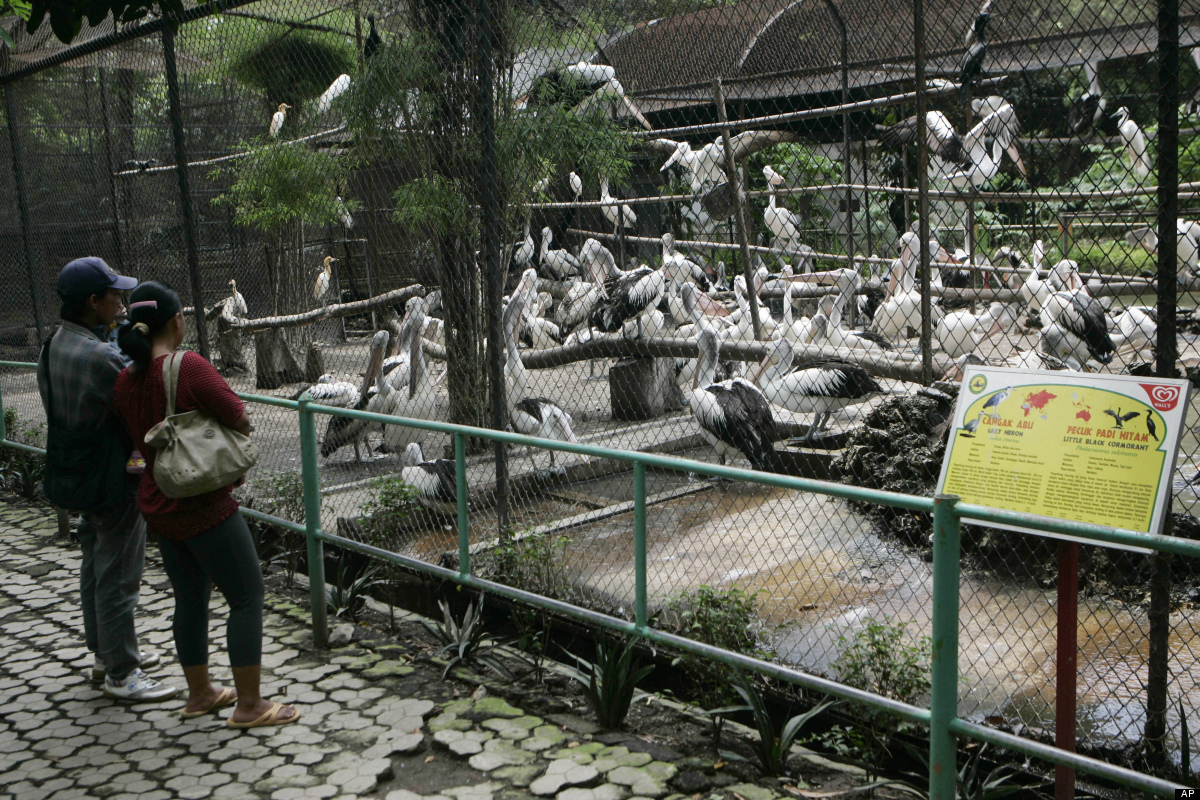
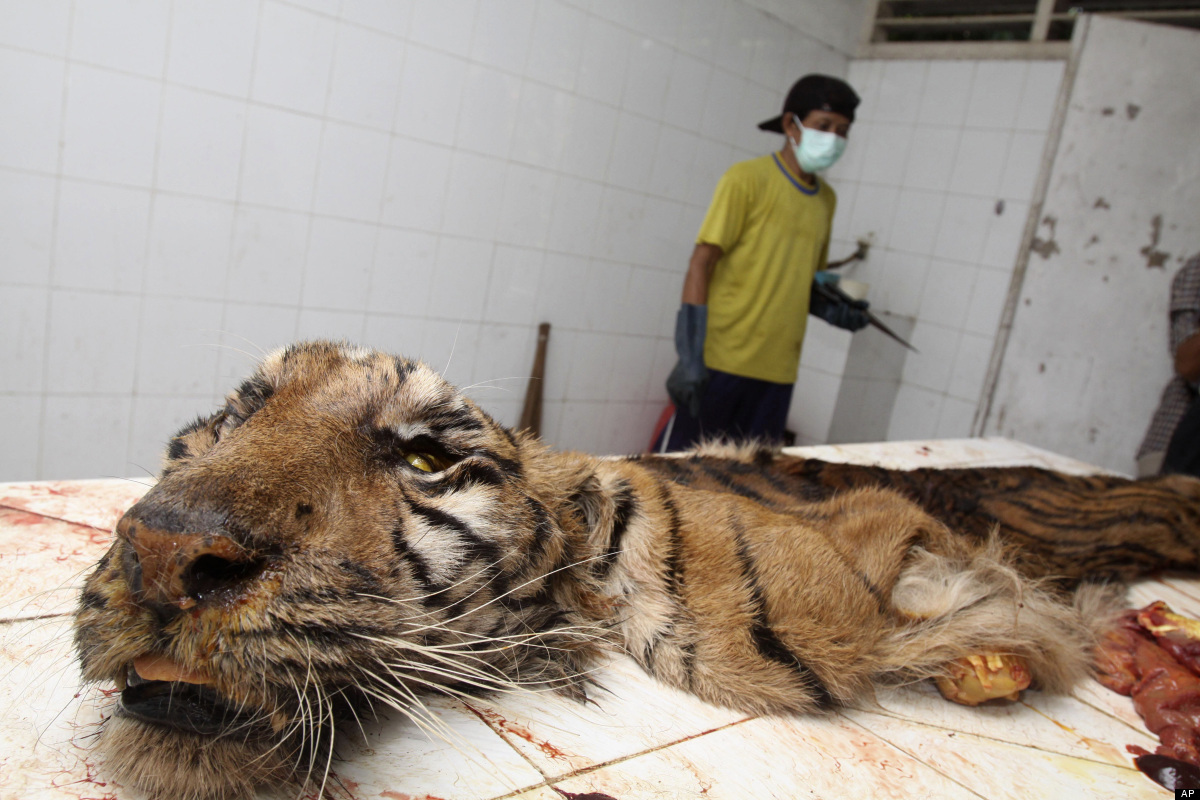
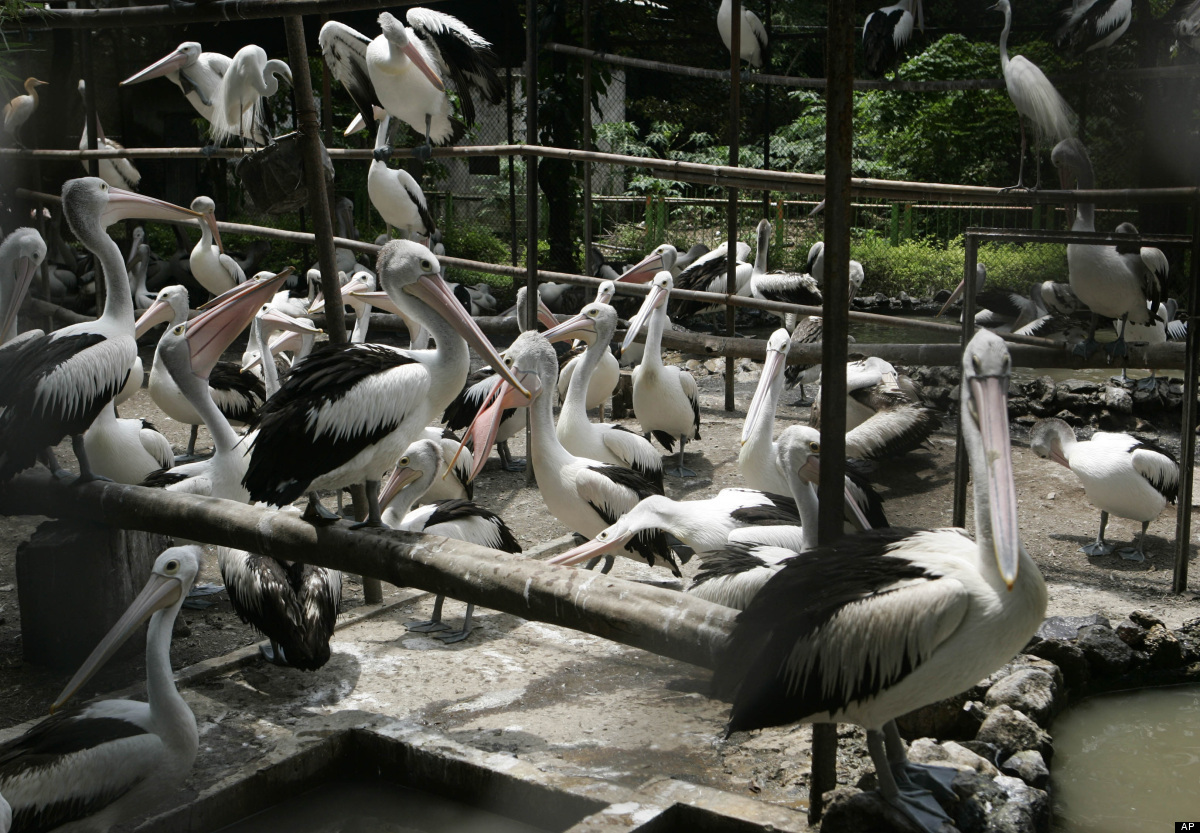
SURABAYA, Indonesia (AP) — The tigers are emaciated and the 180 pelicans packed so tightly they cannot unfurl their wings without hitting a neighbor. Last week, a giraffe died with a beachball-sized wad of plastic food wrappers in its belly.

That death has focused new attention on the scandalous conditions at Indonesia's largest zoo. Set up nearly a century ago in one the most biologically diverse corners of the planet, it once boasted the most impressive collection in Southeast Asia.

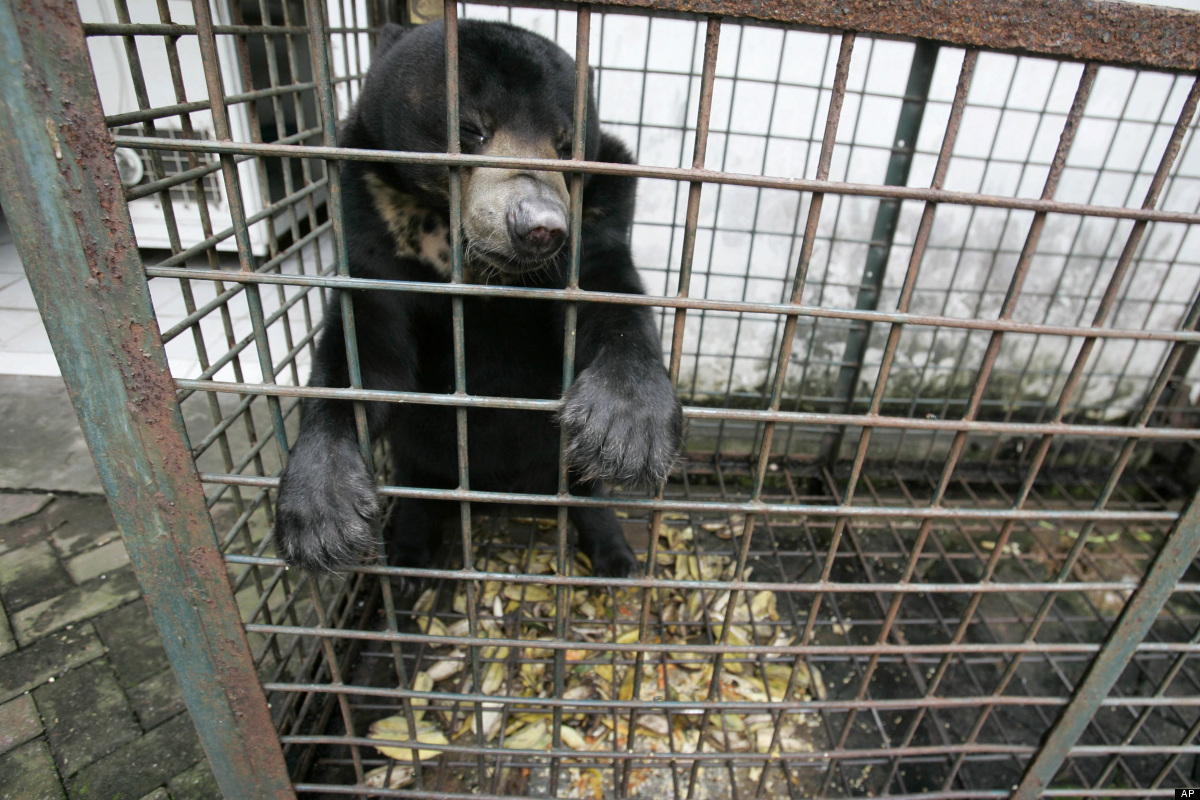
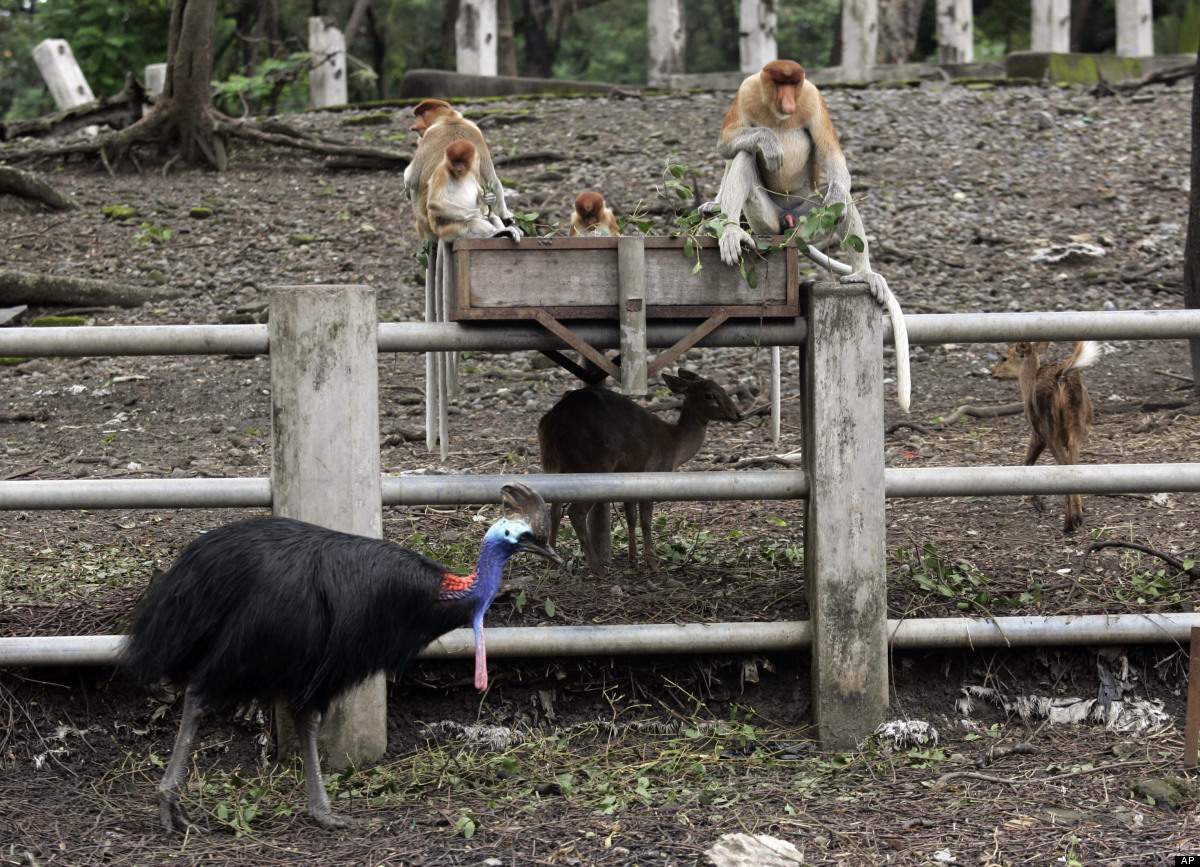
But today the Surabaya Zoo is a nightmare, plagued by uncontrolled breeding, a lack of funding for general animal welfare and even persistent suspicions that members of its own staff are involved in illegal wildlife trafficking.

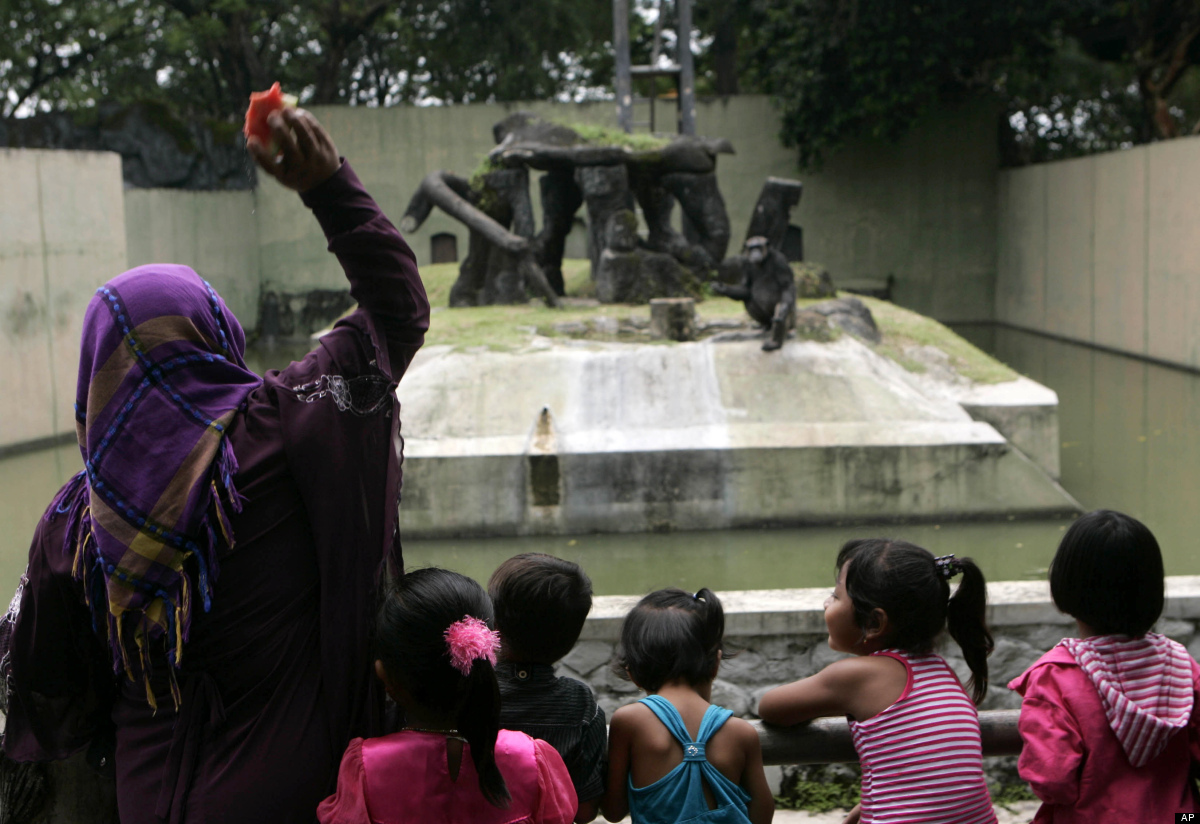
The rarest species, including Komodo dragons and critically endangered orangutans, sit in dank, unsanitary cages, filling up on peanuts tossed over the fence by giggling visitors.

"This is extremely tragic, but of course by no means surprising in Indonesia's zoos, given the appalling way they are managed on the whole," said Ian Singleton, a former zookeeper who now runs an orangutan conservation program on Sumatra island.

The zoo came under heavy fire two years ago following reports that 25 of its 4,000 animals were dying every month, almost all of them prematurely. They included an African lion, a Sumatran tiger and several crocodiles.

The government appointed an experienced zookeeper, Tony Sumampouw, to clean up the operation and he struggled, with some success, to bring the mortality rate down to about 15 per month.

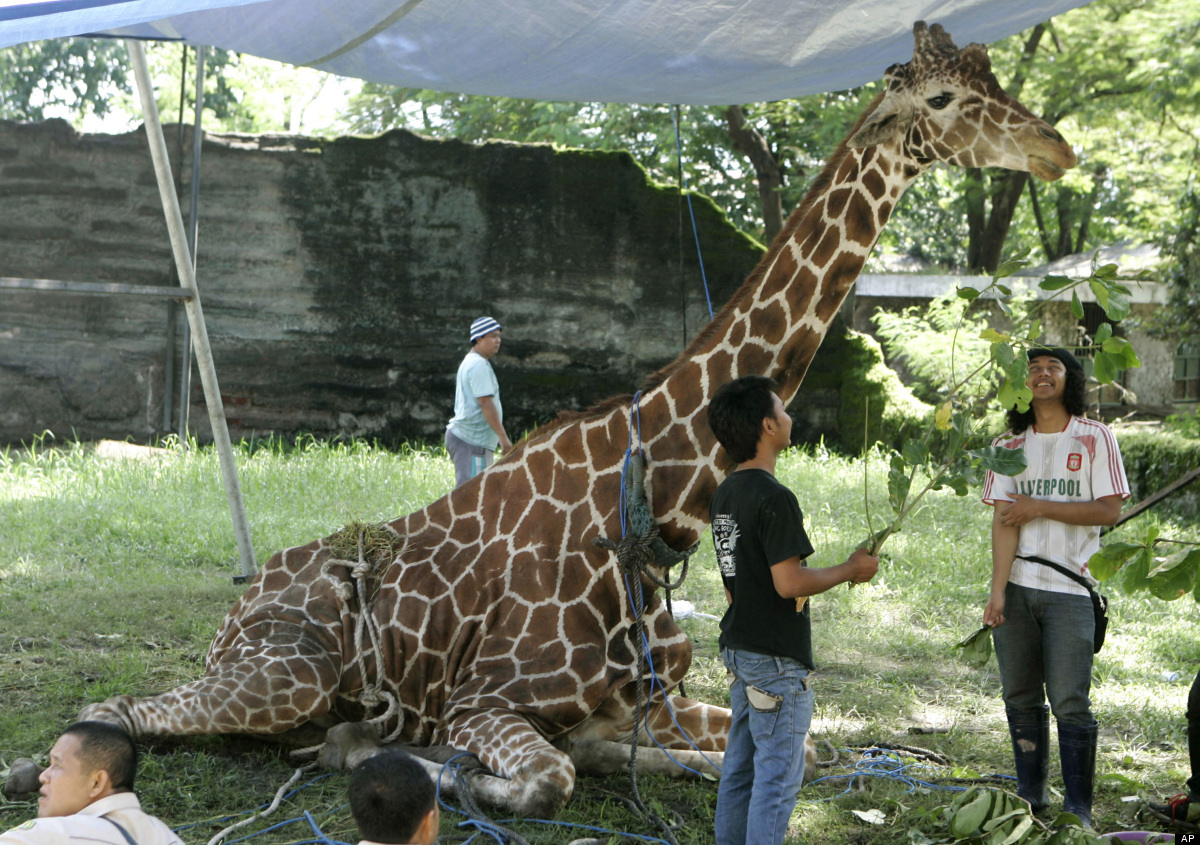
But following last week's death of the 30-year-old giraffe "Kliwon" — who had for years been eating litter and trash thrown into its pen and was found with a 18-kilogram (40-pound) ball of plastic in its stomach — Sumampouw said he's all but given up.

Nothing short of a "total renovation" is needed, he said.

"We need to either think about privatizing or transferring out some of the animals."

With entrance fees of less than $2, critics say there's not enough money to care for the animals, much less invest in improving the zoo's facilities.

One of the biggest problems is overcrowding.

Whereas most zoos limit the number of animals born in captivity — taking into consideration how many can reasonably be cared for or exchanged with other zoos — the notion of "family planning" has not yet taken off here.

 Contraceptives are expensive and there are not adequate facilities to separate males and females. As result, species at the Surabaya zoo are bred to excess.

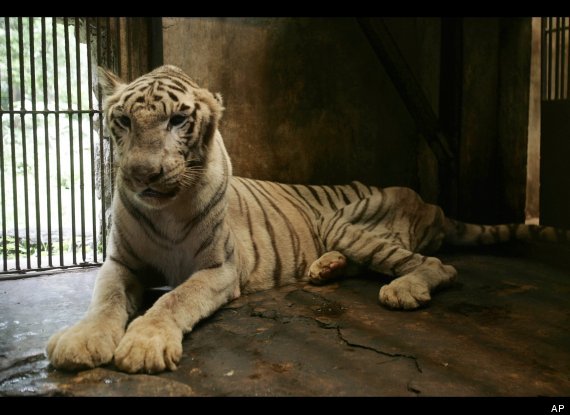
The 180 pelicans are kept in a pen the size of a volleyball court. Nearby, 16 tigers — 12 Sumatran and four Bengalese — are kept in a prison-like row of concrete cages.

One white tiger, whose parents were donated by the Indian government nearly 20 years ago, is now covered by skin lesions.

Let out so rarely, she suffers from back complications that make it difficult to just stand up, let alone walk, zoo curator Sri Pentawati said.

"There are too many tigers," she lamented. "We have a hard time rotating them out to get all the exercise they need."

Rahmat Shah — a well known big-game hunter with a museum in the city of Medan that is filled with rhinos, big cats and other animals he's shot around the world — currently heads Indonesia's National Zoo

Association. He says none of the zoos run by the government are in good condition, but that Surabaya is especially troubled, due to a bitter internal rift.

Two men who each claimed to be the zoo's chief were fired several years ago, but their followers among the staff have continued the feud.

Police believe the poisoning death of a Javan warthog in January, found with traces of cyanide in its stomach, was linked to that conflict.

"One side is always trying to discredit the other," said Ludvie Achmad, head of a local conservation agency.
Sumampouw acknowledged he has had little success in controlling the undisciplined staff.

He said he believes some animals, including three young Komodos that disappeared last year, were stolen by caretakers and sold into the exotic pet trade.

Zookeepers also have been accused of taking meat meant for the tigers and selling it in the local market.
___

Associated Press writer Ali Kotarumalos in Jakarta contributed to this report.

PHOTOS (Warning - Some images are GRAPHIC): 


Donald Trump's Sons Defend Safari Killing Spree In Zimbabwe


Donald Trump has long faced criticism over his environmental track record. Now, it's his sons who are in the spotlight for similar behavior.

Animal rights group PETA is criticizing the pair after newly released photos show the brothers on a safari in Zimbabwe last year, where they hunted and killed a slew of animals.

"If the young Trumps are looking for a thrill, perhaps they should consider skydiving, bungee jumping, or even following in their anti-hunting father's footsteps and taking down competing businesses—not wild animals," PETA said in a statement to E! News.

First reported by Wildlife Extra, the images made their way to YouTube and show Eric Trump and Donald Trump Jr. posing with the hunted trophy game.

According to TMZ, the brothers managed to shoot a variety of animals, including an elephant, crocodile, kudu, civet cat and water buck.

In response to the criticism, the eldest Trump brother took to Twitter to defend their safari.

"I'm a hunter, for that I make no apologies," Donald Trump, Jr. said on Twitter. "I can assure you it was not wasteful the villagers were so happy for the meat which they don't often get to eat," he later added.

He later continued his defense, referring directly complaints that the animals he and his brother had killed, namely elephants, had shrinking populations.

"In some parts its over populated." “Bottom line with out hunters $ there wouldn't be much left of africa. Eco is nice but no $," he tweeted.

While trophy hunting is legal in many African countries -- often provided hunters buy expensive licenses -- conservationists believe the practice is responsible for the diminishing populations of many vulnerable, threatened or endangered species.

For instance, just last November, the western Black Rhino of Africa was officially declared extinct by a conservation group.

According to TIME magazine's report "Killing Fields", Asian poachers and smugglers have posed as trophy hunters to access Africa's rare rhino horn.

Trophy hunters argue the expensive licenses help pay for wildlife conservation, as the fees can be used to protect natural habitats.

While the number of animals that are allowed to be killed and exported is controlled by the UN-run Convention on International Trade in Endangered Species of Wild Fauna and Flora (CITES), the Guardian explains that some argue the system is flawed given it's up to national governments -- some of which are short on cash -- to keep track and report the wildlife quotas.

Tuesday, 13 March 2012

Rick Santorum Primary Results: The Undead Presidential Candidate Down South


WASHINGTON -- Rick Santorum on Tuesday became the undead candidate for president.

Rick Santorum was close to being left for a goner before the results from Mississippi and Alabama were in. Polls showed him behind Mitt Romney and Newt Gingrich in both states, and political observers were prepared to see him finish third in both. Such a result would have left his candidacy badly injured, and the vibe from Santorum's own campaign was morose.

But Santorum shocked the political world and won both states. He won Alabama with 34.6 percent to Gingrich's 29.3 percent and Romney's 28.9 percent, with 94 percent of the vote counted. He won Mississippi in a closer contest, 32.9 percent to 31.3 percent for Gingrich and 30.3 percent for Romney, with 98 percent counted.

It was exactly the kind of victory Santorum had heretofore lacked, one in which he beat Romney and Gingrich in a high-stakes match that all three candidates were badly trying to win.

"We did it again," Santorum told a cheering crowd of supporters in Lafayette, La., where voters will go to the polls on March 24. "This campaign is about ordinary folks doing extraordinary things, sort of like America."

"I don't think there was a single poll that had me anywhere close in Mississippi," he said.

The spin that Santorum's campaign was trying to sell before the results came in -– when most people including them seemed to assume that Santorum would lose the two southern contests -– will now get a fresh look.

 Their case is that Santorum can catch up to Romney in the delegate race in part by gaining at the state conventions that are to come, the final step where delegates are selected to go to the national convention in Tampa this August.

But the only way that is ever going to happen is if Santorum gains a groundswell of support among the Republican grassroots that could sweep through the country and move enough support his way that substantial numbers of delegates are persuaded to move their support away from other candidates and toward him.

The delegate and state convention process is arcane, complicated, and varies from state to state. But the more important and basic point is that if Santorum keeps winning, in Missouri on Saturday, in Illinois in a week, and in Louisiana on March 24, then there will be a growing energy behind his candidacy that the Romney campaign in Boston will not be able to dismiss with talk of delegate math.

That's because the grassroots energy and momentum is a major factor that could affect the delegate math in a real way, both at state conventions and at the national convention if it ends up being contested.

One candidate needs to reach 1,144 delegates to clinch the nomination, and it's possible that none of them
can reach that number before Tampa. In that case, the nomination could come down to a convention in which there are multiple votes to decide a candidate.

But Santorum said Tuesday night in his victory speech that "we are going to win this nomination before that convention."

Romney, for his part, emphasized the number of delegates he was able to win because the states allocate their delegates proportionally, rather than winner-take-all.

 He was expected to reap most of the delegates from two other contests in Hawaii and American Samoa, which will award 17 delegates and 6 delegates respectively.

"I am pleased that we will be increasing our delegate count in a very substantial way after tonight," Romney, who did not hold a election night rally, said in a statement. "With the delegates won tonight, we are even closer to the nomination."

The Associated Press estimated that Romney would receive at least seven of Alabama's 47 delegates, and at least 11 of Mississippi's 37 delegates.

Romney had 472 delegates to Santorum's 244, Gingrich's 127 and 47 for Rep. Ron Paul (R-Texas), after the Mississippi and Alabama results, according to AP estimates.

Santorum's win on Tuesday was a dream scenario in creating pressure on Gingrich, the former House speaker from Georgia, to drop out.

 Gingrich acknowledged that a second-place finish in both states "wasn't as much as we wanted." But he also vowed to stay in the race.

Nevertheless, the pressure on him to quit will be intense, and will at least accentuate that Santorum is clearly the conservative grassroots' preferred choice to take on Romney in a one-on-one contest.

 That might sideline Gingrich to the point that Santorum begins picking up large swaths of his support.

"After tonight this is going to be a two-man race. It's going to be Rick and Mitt, and we're going to clear the field and Rick's got a good shot down the road," said Santorum spokeswoman Alice Stewart, on CNN.

John Brabender, a senior adviser to Santorum, did not call on Gingrich to exit, but said in a separate interview on CNN after the results came in: "I think to be honest with you that we've earned a one-on-one with Mitt Romney."

Late in the night, there were moves by the Gingrich campaign to begin floating the idea of a Gingrich-Santorum ticket.

"Newt Gingrich and Rick Santorum would make a powerful team against Barack Obama," a senior Gingrich adviser told The Huffington Post in an email. "They have the capability to deny Gov. Romney the nomination."

Monday, 12 March 2012

Syria: 'Children Burned Alive In Front Of Their Mothers' Report Activists In Homs

Syrians in the devastated city of Homs have described the harrowing moment that government forces rounded up whole families, divided the children from their mothers and then burned them alive.

The families were reportedly arrested in the Karm el-Zeytoun and Adawiya neighbourhoods of the city.

One Homs resident known as 'Yazn' told the protest network Avaaz how the families were brutally executed in turn:

"They handed them over to the security forces and Shabiha militia who separated the men from the women and children.

"They shot the men and burned the others alive. They slaughtered the children in front of their mothers and then raped the women, some of whom were minors."

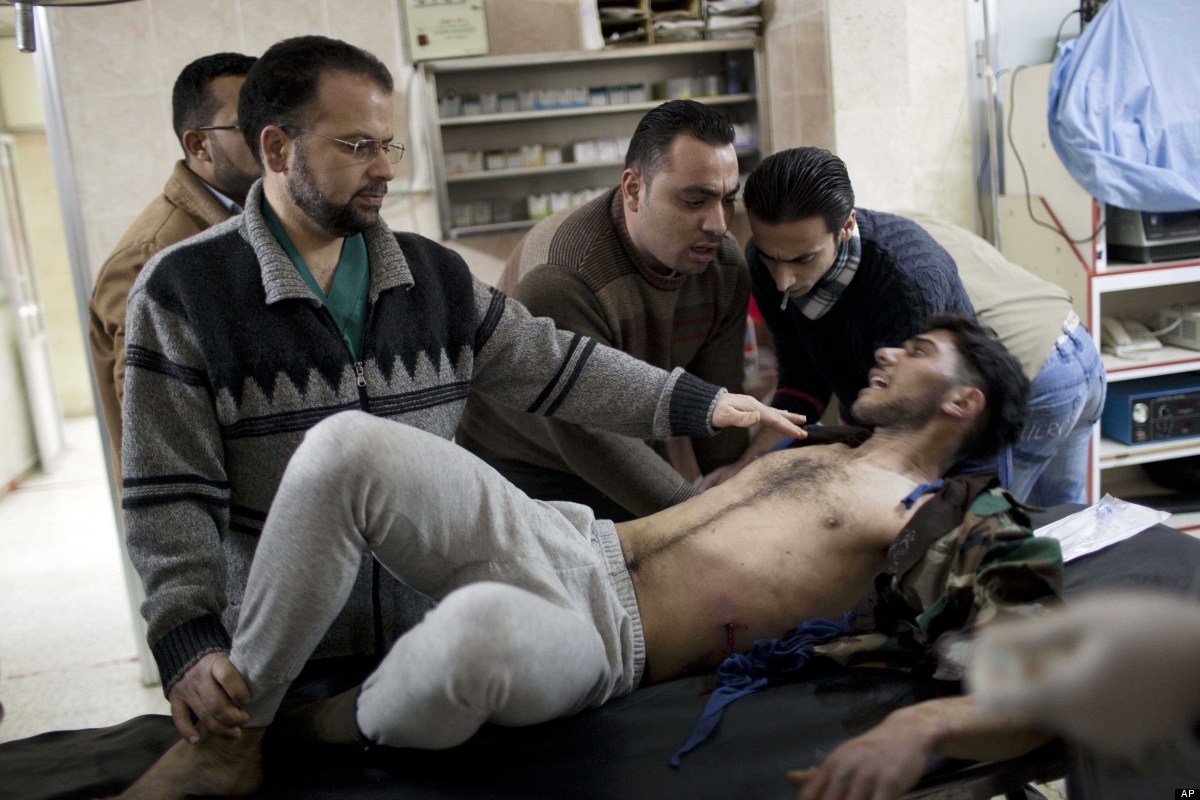
The bodies of at least 26 children and 21 women were discovered in the ruins of the city, said to be victims of a massacre by government security forces.

Members of the opposition were able to take the remains of 47 victims to the Bab al-Sabaa neighbourhood.

The Activists News Association published extremely graphic videos on Facebook which appeared to show the corpses in a field hospital.

Another activist, Abu Yasser, said: "A number of those killed had their bodies desecrated with sectarian phrases. The regime is desperate to ignite sectarian conflict between Sunnis and Alawites in the city."

Avaaz said: "Meantime citizen journalists report that the army continues to shell the old districts of Homs with mortar and heavy machine-gun fire. Snipers are also everywhere and the streets are mainly empty."

The BBC described how many other families have been left to wander the streets of Homs homeless after their lives were wrecked in more than four weeks of continuous bombardment.

The city has been subject to an assault by the Syrian army for weeks, and attacks have continued even after opposition forces withdrew under pressure from intense shelling.

Avaaz also said that increased mortar attacks in the city of Idlib were driving civilians into the town of Homs, the site of a crack down on the regime's opposition in 1982 in which 10,000 people were killed by President Assad's predecessor, his father Hafez Assad.

Elsewhere British Foreign Secretary William Hague pushed the UN security council to adopt a resolution condemning the violence after a weekend of diplomatic efforts by UN and Arab League special envoy Kofi Annan did not lead to a hoped-for breakthrough.

Annan said that he was "optimistic" following the talks, and that if enacted his "concrete proposals" could lead to a ceasefire.

He added that every Syrian "wants peace".

Critics said that President Assad had rejected all talks with "armed terrorist groups", meaning the increasingly militarised opposition movement, and had given no ground over his own personal hold on power.

Assad said during the talks: "No political dialogue or political activity can succeed while there are armed terrorist groups operating and spreading chaos and instability."

Dr Bassma Kodmani, with the opposition Syrian National Council, told the BBC Assad had to stand down.
He said that Assad leaving office was a "first condition" of any negotiation.

Large-scale demonstrations against Assad's rule, including some in central Damscus were reported on Sunday evening, after a weekend of violence.

The UN says that at least 7,500 people have been killed since the start of the uprising 12 months ago.


Friday, 9 March 2012

Gov. Chris Christie Calls Veteran An 'Idiot' In Shouting Match


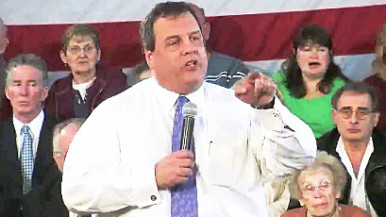
Gov. Chris Christie argued with a former Navy SEAL Thursday over the state's plans to reconfigure public universities in New Jersey -- resulting in Christie calling the man an idiot.

William Brown -- a Rutgers-Camden law student opposes the governor's plan to merge his school with Rowan University, according to the Philadelphia Inquirer.

Brown asked the governor during a town hall meeting in Burlington County to consider how the merger would affect students, and veteran students in particular, before going ahead with his plan. Christie responded by telling Brown the merger was going to happen because it would provide bigger and better opportunities.

The situation escalated into a shouting match, and Brown continued to make his argument while Christie was speaking, saying that no one in South Jersey wanted this to happen.

Christie ordered Brown escorted out and said, "If you decide what you want to do is put on a show today, let me tell you something, I can go back and forth with you as much as you want. And let me tell you something, after you graduate from law school, you conduct yourself like that in a court room, your rear end’s gonna get thrown in jail, idiot."

After Brown left, Christie said, "You know, I tried to be patient with the guy. Every time I tried to answer, he started yelling over me again. Damn, man, I’m governor, could you just shut up for a second?"

Brown told the Philadelphia Inquirier after the encounter that he worried that the merger would hamper educational opportunities that now exist for veterans and other nontraditional students like himself.
Brown called the response by Christie and the police "inappropriate."

"I think he's a bully sometimes," Brown said. "I was disappointed the governor couldn't have a debate."

Wednesday, 7 March 2012

Obama Harvard Video Released, Shows Young Obama At 1991 Protest For Derrick Bell, Diversity (UPDATE)


Before Andrew Breitbart's unexpected death, the conservative blogger and journalist had promised to release video footage of President Barack Obama that he said would change the election. Now, BuzzFeed has unearthed the video it believes Breitbart was referring to, according to the site's editor-in-chief, Ben Smith.
If this is indeed the footage in question, it's not particularly controversial.
In the 1991 video, which BuzzFeed licensed from WGBH Boston, a young Obama is shown speaking in support of Harvard's first tenured black law professor, Derrick Bell. Bell was staging a protest over the lack of female black professors at the school, and was taking an unpaid leave until Harvard hired a woman of color.
As Bell said at the time, "My major effort in teaching is to convince students ... that they should be ready and able to take risks and make sacrifices for the things they believe in, and their real success in life will come from making those sacrifices and taking those risks, regardless of outcome. The best way to teach that is to practice it."
In the video, Obama, who was then president of the Harvard Law Review, is shown praising Bell, while the professor stands nearby and a crowd cheers. Obama recalls how Bell spoke at an orientation for first-year students, and instead of lecturing the students, encouraged conversation.
Obama doesn't sound much different than he does today, though his presentation has improved (he keeps his hands stuffed in his pockets during his entire speech). He employs his now-signature charm, flattering Bell's "good looks" and the "excellence of his scholarship."
The video ends with Obama urging the crowd to open up their hearts and minds to Bell.
Big Government, a conservative website founded by Breitbart, is claiming that the video released by BuzzFeed is selectively edited. It promises more video to come shortly.
BuzzFeed denied editing the video, and said the site published the video they purchased from WGBH in its entirety.
UPDATE: Two Breitbart.com editors went on Sean Hannity's Fox show on Wednesday night and revealed a slightly longer version of the video.
The difference between BuzzFeed's video and the one provided by Breitbart.com? A hug between Obama and Bell.
Hannity also showed a new video, this one of Harvard professor Charles Ogletree taken during a lecture. Ogletree plays the video of Obama at the 1991 protest, and quips that the clip had been "hidden" during the 2008 election. "Of course we hid this throughout the 2008 campaign," he said, as students laughed. "I don't care if they find it now."
Although the clip of the two men hugging may not be well-known, it hasn't exactly been hidden from the public. It was included in the 2008 FRONTLINE special, 'The Choice 2008.'

Tuesday, 6 March 2012

Super Tuesday Results 2012: Live Updates


The Super Tuesday results from races in ten states will determine how a total of 419 delegates are awarded to contenders competing in the Republican primary.

To secure the GOP presidential nomination, a candidate must secure 1,144 delegates.
Former Massachusetts Gov. Mitt Romney went into Super Tuesday running ahead of the pack, but former U.S. Senator Rick Santorum, former House Speaker Newt Gingrich and U.S. Rep. Ron Paul are determined to give the former Massachusetts governor a run for his money and show no signs of plans to abandon their respective campaigns.

Voters in the following states cast ballots on Super Tuesday: Alaska, Georgia, Idaho, Massachusetts, North Dakota, Ohio, Oklahoma, Tennessee, Vermont and Virginia.

From delegates to endorsements, check out HuffPost Election Dashboard for a rundown on where the candidates stand in the primary race.

Below, a live blog of the latest Super Tuesday developments to unfold.

Newt Gingrich Caught Nodding Off Before Speaking To AIPAC Conference (VIDEO)


video platformvideo managementvideo solutionsvideo player


Newt Gingrich was caught nodding off before he spoke at the America Israel Public Affairs Committee Tuesday.

ABC News captured a video of the former House speaker closing his eyes before he spoke via satellite feed to the audience. "Listening to [Secretary of Defense Leon] Panetta is not a relaxing experience," he said before going live.

The former House speaker went on to say that he looked forward to the panel's questions. Mitt Romney, who spoke earlier, had taken questions from a panel following his speech. Rick Santorum, however, did not.

There was a pause and the introducer said there were no questions and he could continue. Gingrich then went ahead and began his remarks, which targeted President Barack Obama over his position on Iran.

However, he was later interrupted for two questions from the same AIPAC board member.

Gingrich campaigned in Alabama and Georgia ahead of watching the election results in Atlanta. He has vowed to win the Georgia primary, where he served in the U.S. House for 20 years.

Sunday, 4 March 2012

Kentucky Tornadoes 2012: Indiana, Alabama And Other States Recover From Storm


EAST BERNSTADT, Ky. (AP) — The stories from tornado survivors across the South and Midwest were remarkable: schoolchildren took cover under desks, people hunkered down in a church basement or hid out in a bank vault. One family even piled on top of one another for protection.
 
One story had yet to be told. A toddler was found alive and alone in a field near her Indiana home. Her four immediate family members were among at least 38 people killed by tornadoes that scarred communities scattered across hundreds of miles of the nation's midsection from Alabama to Indiana.

In Kentucky farming country, people talked about friends and family members who were killed in the most powerful storms to hit the eastern part of the state in nearly a quarter-century.

Tracy Pitman said she was at home with her husband and 4-year-old grandson when a tornado with winds of up to 130 mph hit.

"I grabbed my baby and I said, 'Baby, lay down' and I got on top of him and my husband got on top of me and it was already happening, just flipping us over and over and over," said Pitman, of East Bernstadt, Ky., a small town 70 miles south of Lexington.

As the accounts were passed around, emergency officials trudged with search dogs past knocked-down cellphone towers and ruined homes looking for survivors in rural Kentucky and Indiana, marking searched roads and homes with orange paint.

 President Barack Obama offered federal assistance.

The worst damage appeared centered in some hard-hit small towns of southern Indiana and eastern Kentucky's Appalachian foothills.

 No building was untouched and few were recognizable in West Liberty, Ky., about 90 miles from Lexington, where two white police cruisers were picked up and tossed into City Hall.

"We stood in the parking lot and watched it coming," said David Ison, who raced into a bank vault with nine others to seek safety. "By the time it hit, it was like a whiteout."
The spate of storms was the second in little more than 48 hours, after an earlier round killed 13 people in the Midwest and South.

 They were the latest in a string of severe-weather episodes that have ravaged the heartland in the past year.
Friday's violent storms touched down in at least a dozen states, killing 19 people in Kentucky, 14 in Indiana, three in Ohio, and one each in Alabama and Georgia.

The National Weather Service said the four twisters to hit Kentucky were the worst in the region in 24 years.

In Indiana, an EF-4 tornado — the second-highest on the Fujita scale that measures tornadic force — packing 175 mph winds hit the town of Henryville, and stayed on the ground for more than 50 miles. Three tornadoes in Kentucky had wind speeds up to 160 mph.

The storms left behind a trail of shredded sheet metal, insulation, gutted churches and crunched-up cars.

The trailer that was once the home of Viva Johnson's mother was sitting in a graveyard on Saturday, covering the dead alongside downed trees and other debris.

 "You can't even tell where the headstones are," said Johnson, who lives in Pulaski County, Ky.

In Indiana, a toddler was found alone in a field near her family's home after a tornado hit in New Pekin.

Authorities learned Saturday she is the sole survivor of her immediate family, said Cis Gruebbel, a spokeswoman for Kosair Children's Hospital in Louisville, Ky.

 The girl's mother, father, 2-month-old sister and 2-year-old brother all died Friday, Washington County Coroner Rondale Brishaber said.

The toddler was in critical condition with extended family members at the hospital. Authorities are still trying to figure out how she ended up in the field.

"She is in extremely critical condition," Jack Brough, the girl's grandfather, told The Courier-Journal of Louisville.

 "She's had a lot of injuries to her head. The doctors told us that the next 24-48 hours are very critical."

The girl's mother, father, 2-month-old sister and 3-year-old brother all died Friday, Gruebbel said.

About 20 miles east, a twister demolished Henryville, Ind., the birthplace of Kentucky Fried Chicken founder "Colonel" Harland Sanders.

The second story of the elementary school was torn away, one of the city's three schools lost to the weather.

The winds also blew out the windows and gutted the Henryville Community Presbyterian Church.

A school secretary said a bus left the city's high school Friday afternoon with 11 children, but the driver turned back after realizing they were driving straight into the storm.

The children hid under tables and desks at the school nurse's station when the tornado hit; none were hurt, but the building is a total loss.

The school bus was tossed several hundred yards into the side of a nearby restaurant. Todd and Julie Money were hiding there, having fled their Scottsburg home because it has no basement.

"Unreal. The pressure on your body, your ears pop, trees snap," Todd Money said. "When that bus hit the building, we thought it exploded."

The storms hit as far east as Ohio, where the Ohio River town of Moscow was so decimated that rugs hung from the trees.

In Kentucky, the Rev. Kenneth Jett of the West Liberty United Methodist Church was huddling with four others in the basement as the church collapsed.

The pastor and his wife had just returned to the parsonage when he turned on the TV and saw that the storm coming.

 Jett yelled to his wife to take shelter in the basement of the church next door, where they were joined by two congregants and a neighbor.

The last one down was Jett's wife, Jeanene.

"I just heard this terrific noise," she said. "The windows were blowing out as I came down the stairs."

They only had some bumps and bruises, able to escape the rubble through a basement door.

Friday's tornado outbreak had been forecast for days; meteorologists at the National Weather Service's Storm Prediction Center had said the day would be one of a handful this year that warranted its highest risk level.

 The weather service issued 297 tornado warnings and 388 severe thunderstorm warnings from Friday through early Saturday.

In April, when tornadoes killed more than 240 people in Alabama, it issued 688 tornado warnings and 757 severe thunderstorm warnings from Texas to New York, said Greg Carbin, warning coordination meteorologist at the storm prediction center.

In Harvest, Ala., which was hit last April, Cody Stewart said he was done owning a home for the time being after his house was damaged a second time.

In his house for less than two months with repairs still incomplete, a tornado on Friday ripped the roof away and slung it into the backyard. This time, the damage is beyond repair.

"I think I'm going to live in an apartment awhile. I'm not superstitious, but it just kind of seems there's a path here and I don't want to be in it again, and I hope other people make the same choice," Stewart said.

Suhr reported from New Pekin, Ind. Associated Press writers Kate Brumback in Chattanooga, Tenn., Tom LoBianco in Indianapolis and Bruce Schreiner in East Bernstadt, Ky., contributed to this report.

Suhr reported from New Pekin, Ind. Associated Press writers Roger Alford in West Liberty, Ky., Kate Brumback in Chattanooga, Tenn., Tom LoBianco in Indianapolis, contributed to this report.

Indiana Tornado Outbreak 2012: More Than 30 People Killed As Violent Storms Hit Indiana, Kentucky


WEST LIBERTY, Ky. — Across the South and Midwest, survivors emerged Saturday to find blue sky and splinters where homes once stood, cars flung into buildings and communications crippled after dozens of tornadoes chainsawed through a region of millions, leveling small towns along the way.

At least 38 people were killed in five states, but a 2-year-old girl was somehow found alive and alone in a field near her Indiana home. Her family did not survive.

A couple that fled their home for the safety of a restaurant basement made it, even after the storms threw a school bus into their makeshift shelter.

Saturday was a day filled with such stories, told as emergency officials trudged with search dogs past knocked-down cellphone towers and ruined homes looking for survivors in rural Kentucky and Indiana, marking searched roads and homes with orange paint. President Barack Obama offered federal assistance, and Ohio Gov. John Kasich declared an emergency Saturday.

The worst damage appeared centered in the small towns of southern Indiana and eastern Kentucky's Appalachian foothills.

 No building was untouched and few were recognizable in West Liberty, Ky., about 90 miles from Lexington, where two white police cruisers were picked up and tossed into City Hall.

"We stood in the parking lot and watched it coming," said David Ison, who raced into a bank vault with nine others to seek safety. "By the time it hit, it was like a whiteout."

In East Bernstadt, two hours to the southwest, Carol Rhodes clutched four VHS tapes she'd found in debris of her former home as she sobbed under a bright sun Saturday.

"It was like whoo, that was it," said Rhodes, 63, who took refuge with four family members in a basement bedroom that she had just refinished for a grandchild.

"Honey, I felt the wind and I said, `Oh my God,' and then it (the house) was gone. I looked up and I could see the sky."

The spate of storms was the second in little more than 48 hours, after an earlier round killed 13 people in the Midwest and South, and the latest in a string of severe-weather episodes that have ravaged the American heartland in the past year.
Friday's violent storms touched down in at least a dozen states from Georgia to Illinois, killing 19 people in Kentucky, 14 in Indiana, three in Ohio, and one each in Alabama and Georgia.

The National Weather Service said the four twisters to hit Kentucky were the worst in the region in 24 years.

 In Indiana, an EF-4 tornado – the second-highest on the Fujita scale that measures tornadic force – packing 175 mph winds hit the town of Henryville, and stayed on the ground for more than 50 miles.

The storms scarred the landscape over hundreds of miles, leaving behind a trail of shredded sheet metal, insulation, gutted churches, crunched-up cars and even a fire hydrant.

The trailer that was once the home of Viva Johnson's mother was sitting in a graveyard on Saturday, covering the dead alongside downed trees and other debris. "You can't even tell where the headstones are," said Johnson, who lives in Pulaski County, Ky.

In Indiana, a toddler was found alone in a field near her family's home after a tornado hit in New Pekin. Authorities learned Saturday she is the sole survivor of her immediate family, said Cis Gruebbel, a spokeswoman for Kosair Children's Hospital in Louisville, Ky.

The girl's mother, father, 2-month-old sister and 2-year-old brother all died Friday, Washington County Coroner Rondale Brishaber said.She is in critical condition with extended family members at the hospital, and authorities are still trying to figure out how she ended up in the field.

"She is in extremely critical condition," Jack Brough, the girl's grandfather, told The Courier-Journal of Louisville. "She's had a lot of injuries to her head. The doctors told us that the next 24-48 hours are very critical."

About 20 miles east, a twister demolished Henryville, Ind., the birthplace of Kentucky Fried Chicken founder "Colonel" Harland Sanders.

The second story of the elementary school was torn off, one of the city's three schools lost to weather; the punishing winds blew out the windows and gutted the Henryville Community Presbyterian Church.

A school secretary said a bus left the city's high school Friday afternoon with 11 children, but the driver turned back after realizing they were driving straight into the storm.

The children hid under tables and desks at the school nurse's station when the tornado hit; none were hurt, but the building is a total loss.

The school bus was tossed several hundred yards into the side of a nearby restaurant. Todd and Julie Money were hiding there, having fled their Scottsburg home because it has no basement.

"Unreal. The pressure on your body, your ears pop, trees snap," Todd Money said. "When that bus hit the building, we thought it exploded."

The storms hit as far east as Ohio, where the Ohio River town of Moscow was so decimated that rugs hung from the trees.

"This half is gone and that half is damaged," said village native Steve Newberry, who was permitted into town Saturday to pick up medical supplies for his mother.

In Kentucky, the Rev. Kenneth Jett of the West Liberty United Methodist Church was huddling with four others in the basement as the church collapsed.

The pastor and his wife had just returned to the parsonage when he turned on the TV and saw that the storm was coming. Jett yelled to his wife to take shelter in the basement of the church next door, where they were joined by two congregants and a neighbor.
The last one down was Jett's wife, Jeanene.

"I just heard this terrific noise," she said. "The windows were blowing out as I came down the stairs."

The building collapsed, but they were able to get out through a basement door. They escaped with only bumps and bruises.

Janet Elliott was sitting on her bed in Chattanooga, Tenn., when a severe weather warning scrolled across the bottom of the screen. Fierce winds were blowing, and her cats seemed clingy. Her dogs had gotten low to the floor.

She ran to the basement and tried to pull the door shut, but she couldn't. She heard a ripping sound as the ceiling peeled off and wind wrenched the doorknob from her hand.

"I looked up and I could see the sky," she said. "I realized if I had stayed on the bed two seconds longer, I would have been sucked out or crushed."

In Washington County, Ind., residents saw a massive tornado come over a hill and plow through a grove of trees.

When the winds had passed, it looked as if a line of bulldozers had rolled through.
Gene Lewellyn, his son and his son's 7-year-old daughter saw the tornado come over the hill, rushed to the basement of his one-story brick home and covered themselves with a carpet.

"It just shook once, and it (the house) was gone," said Lewellyn, 62, a retired press operator.

Friday's tornado outbreak had been forecast for days; meteorologists at the National Weather Service's Storm Prediction Center had said the day would be one of a handful this year that warranted its highest risk level.

 The weather service issued 297 tornado warnings and 388 severe thunderstorm warnings from Friday through early Saturday.

In April, when tornadoes killed more than 240 people in Alabama, it issued 688 tornado warnings and 757 severe thunderstorm warnings from Texas to New York, said Greg Carbin, warning coordination meteorologist at the storm prediction center.

It was a distinction without a difference for Lewellyn, who spent Saturday picking through the debris in 38-degree cold.

 His family was safe, but their home was reduced to a pile of bricks and sheet metal wrapped around splintered trees.

 Pieces of insulation coated the ground, and across the street a large trailer picked up by the storm had landed on top of a boat.

"Right now, we are not sure what we are going to do," he said. "We all get out what we can get out."
___
 
Suhr reported from New Pekin, Ind. Associated Press writers Kate Brumback in Chattanooga, Tenn., Tom LoBianco in Indianapolis and Bruce Schreiner in East Bernstadt, Ky., contributed to this report.

Wednesday, 22 February 2012

White House Apologizes For Quran Burning


WASHINGTON -- The White House is apologizing for the burning of Muslim holy books in a pile of garbage at a U.S. military base in Afghanistan.

Press secretary Jay Carney says it's a "deeply unfortunate incident" and doesn't reflect the respect the U.S. military has for the religious practices of the Afghan people.

Carney echoed military officials Tuesday in saying that the Quran burning at Bagram Air Field happened unintentionally, and that an investigation was being undertaken to understand why it did and ensure it didn't happen again.

A Western military official said the Qurans were removed from a library at a nearby detention center because they contained extremist messages. Carney didn't address those specifics, referring questions to defense officials.

Tuesday, 21 February 2012

'I Was Basically Pro-Choice All My Life, Until I Ran For Congress'


WASHINGTON -- Prior to entering public office, former Pennsylvania senator Rick Santorum was a self-admitted pro-choice Republican unwilling to dabble in the cultural conservative politics that now defines his presidential campaign, a review of old campaign documents and interviews shows.

This past week, the Pennsylvania Republican-turned-GOP primary frontrunner made a number of eyebrow raising statements meant to demonstrate an uncompromising posture on social issues.

 He's questioned
President Obama's theology, argued that prenatal testing is a form of eugenics, and stated his opposition for contraception funding.

His campaign has insisted that these are side issues, but when pressed during an interview with MSNBC on Tuesday morning, Santorum's top spokesman Hogan Gidley exulted in his boss' consistency on such topics.

"I mean, that's who he is," Gidley said. "He doesn't have to tack to the right on social issues like Mitt Romney because he actually firmly believes those things."

But Santorum didn't always have such conviction on social policy. In his first run for office in 1990, his campaign put out an issue statement on abortion that, by today's standards, would put him among the moderates of the GOP.

Abortion, he wrote, requires "a sensitivity to the genuine concerns of both sides." While "government must be on the side of human life" he recognized that " it is very difficult to criminalize any activity once a large portion of society comes to see it as a 'right.'"


In practical terms, this meant opposing funding for agencies "whose family planning efforts have encouraged abortion" and support for "approaches (such as crisis-pregnancy centers) that care for the real needs of both the unborn child and the woman facing an extremely difficult situation.

" It also meant that he would not place emphasis on "advocating a Human Life Amendment" and that "abortion in 'hard cases' – rape, incest, and danger to the mother's health – cannot be prohibited by legislation."

During the 2012 presidential campaign, Santorum has argued that those exceptions should not be granted.

The 1990 issue statement was sent to the Huffington Post by an operative who worked on that campaign. Gidley did not return a request for comment on the matter.

As for its validity, a second Democratic source separately said he was "pretty sure" that was the same document.

The statement was referenced in several newspaper articles from that campaign, including a Pittsburgh Press report that noted he withdrew the statement "after settling on a position opposing most forms of legalized abortion."

The senator also discussed his pro-choice origins in an interview he gave five years after defeating Rep. Doug Walgren.

In a December 1995 Philadelphia Magazine article -- which the Huffington Post pulled from Temple

University archives -- Santorum conceded that he "was basically pro-choice all my life, until I ran for Congress... But it had never been something I thought about."

 Asked why he changed his mind, he said that he "sat down and read the literature. Scientific literature," only to correct himself and note that religion was a part of it too.

Sunday, 12 February 2012

Maine Caucus Results 2012: Mitt Romney Wins Contest


PORTLAND, Maine — Mitt Romney narrowly won Maine's Republican caucuses, state party officials announced Saturday, providing his campaign with a much-needed boost after three straight losses earlier this week. But the former Massachusetts governor won just a plurality of the Maine vote, suggesting he haswork to do to unite GOP voters behind his candidacy.

At a gathering in Portland, state Republican Chairman Charlie Webster announced Romney had won with 2,190 votes, or 39 percent, compared to 1,996 – about 36 percent – for Ron Paul, the only other candidate to aggressively compete in the state. Rick Santorum received 989 votes and Newt Gingrich won 349, but neither actively campaigned there. Other candidates drew 61 votes.

The totals reflected about 84 percent of the state's precincts. Webster insisted that any caucus results that come in after Saturday wouldn't be counted no matter how close the vote.

"Some caucuses decided not to participate in this poll and will caucus after this announcement," Webster said. "Their results will not be factored in. The absent votes will not be factored into this announcement after the fact."

Romney's win, combined with his victory in the presidential straw poll at the Conservative Political Action Committee conference in Washington hours earlier, helped slow an embarrassing skid that began Tuesday when he lost contests in Missouri, Minnesota and Colorado to Santorum. The twin triumphs dampened the 

perception – for now – that conservatives were unwilling to support Romney.
Romney's campaign has demonstrated skill and flexibility in winning a big state like Florida and eking out a victory in a low-turnout contest like Maine, where organization and voter contact are essential. Out of Maine's 258,000 registered Republicans, nearly 5,600 cast ballots in the weeklong contest.


But questions about Romney's durability as the party's presumed front-runner persist. Fully 61 percent of Maine voters selected another candidate than Romney in a state practically in his back yard. And Romney's showing was down considerably from 2008, when he won 51 percent of the vote.

Maine's caucuses began Feb. 4 and continued throughout the week. Several communities elected to hold their caucuses at a later date.

Caucuses in Washington County that had been scheduled for Saturday were postponed until Feb. 18 because of a major snowstorm that blanketed the region. Earlier, party Executive Director Michael Quatrano said county officials had been told the results of that caucus would not count toward the total.

But Washington County GOP Chairman Chris Gardner objected, saying he had known his county's tally wouldn't be included in Saturday's announcement but didn't realize it wouldn't be counted at all. He said he had called state party leaders and "expressed my complete and utter dismay."

Gardner, a Romney supporter, said the snowstorm had left him no choice but to postpone the caucuses.
"Refusal to reconsider under those circumstances would be extremely disheartening," he told The Associated Press. "I trust that the party will make the right decision here."

He added, "We will proceed next Saturday. We'll have our vote and we are going to submit it to the state party for them to reconsider."
Many Paul supporters were angry.

"There's a very good chance that you'll find that Washington County goes for Ron Paul," said Mark Willis, a county coordinator for the Paul campaign.
His wife, Violet, added, "We don't want to be disenfranchised."

Webster told reporters there were less than 200 votes in Washington County and he doubted that including them would have changed the outcome.

Speaking to supporters in Portland, Paul expressed disappointment that only a portion of the state's caucuses had counted toward the total.

"I wish all the caucuses had met today," Paul said, adding, "It's almost like we could call it a tie."
Romney was attending a fundraiser in California late Saturday, after visiting caucus sites in Maine earlier in the day, where he pressed voters for their backing.

"I thank the voters of Maine for their support," Romney said in a statement late Saturday. "I'm committed to turning around America. And I'm heartened to have the support of so many good people in this great state."
Romney visited two caucus sites Saturday after abandoning plans to take the day off. The change made clear that his campaign could ill-afford another loss.

Romney also held a town hall-style meeting in Maine on Friday night. It was the first time he'd taken voter questions since campaigning in South Carolina last month.

Maine's nonbinding presidential straw poll had drawn virtually none of the hype surrounding recent contests in Florida and Nevada, where candidates poured millions of dollars into television and radio advertising.
Romney's campaign had placed only a small cable television ad buy airing Friday and Saturday, at a cost of 

several thousand dollars. But he sent surrogates to the state in recent days and hosted a telephone town hall in addition to Friday's campaign stop.
Romney consistently declined to criticize Paul, however.

Instead, he lobbed indirect criticism at Santorum, a former Pennsylvania senator, and Gingrich, a former House speaker, by repeating intensifying rhetoric of recent days that paints them as tainted Washington insiders.

"I have never spent a day in Washington working," Romney said. "I expect to go there, get it fixed and then go home."

He added, "In my home with my mom and dad I learned conservative values. In my faith I learned conservative values. And in my business."

Romney won 11 delegates in Maine and Texas Rep. Ron Paul won 10, according to an analysis by The Associated Press. Former Pennsylvania Sen. Rick Santorum and former House Speaker Newt Gingrich were shut out.

Wednesday, 8 February 2012

The Money Man Behind Rick Santorum: Who Is Foster S. Friess?In this post-Citizens United era, every presidential candidate needs the backing of a super PAC, one of those independent political action committees that can accept unlimited contributions from corporations, unions, other groups and individuals. That even applies to President Barack Obama, who on Tuesday reversed himself and asked his financial backers to donate money to super PACs supporting his reelection campaign. Previously, the president had called unlimited spending by super PACs "a threat to our democracy." Now, says the president, to campaign without one would be to unilaterally disarm. And behind each super PAC, it seems, is at least one extremely wealthy individual, committed for his own reasons to a particular candidate. Newt Gingrich has casino mogul Sheldon Adelson; Rick Santorum, who stunned the political world Tuesday night by winning three (admittedly nonbinding) state GOP contests -- in Colorado, Missouri and Minnesota -- has Foster S. Friess, a hugely successful investor who calls himself, rather immodestly, "the man atop the horse."In this post-Citizens United era, every presidential candidate needs the backing of a super PAC, one of those independent political action committees that can accept unlimited contributions from corporations, unions, other groups and individuals. That even applies to President Barack Obama, who on Tuesday reversed himself and asked his financial backers to donate money to super PACs supporting his reelection campaign. Previously, the president had called unlimited spending by super PACs "a threat to our democracy." Now, says the president, to campaign without one would be to unilaterally disarm. And behind each super PAC, it seems, is at least one extremely wealthy individual, committed for his own reasons to a particular candidate. Newt Gingrich has casino mogul Sheldon Adelson; Rick Santorum, who stunned the political world Tuesday night by winning three (admittedly nonbinding) state GOP contests -- in Colorado, Missouri and Minnesota -- has Foster S. Friess, a hugely successful investor who calls himself, rather immodestly, "the man atop the horse."In this post-Citizens United era, every presidential candidate needs the backing of a super PAC, one of those independent political action committees that can accept unlimited contributions from corporations, unions, other groups and individuals. That even applies to President Barack Obama, who on Tuesday reversed himself and asked his financial backers to donate money to super PACs supporting his reelection campaign. Previously, the president had called unlimited spending by super PACs "a threat to our democracy." Now, says the president, to campaign without one would be to unilaterally disarm. And behind each super PAC, it seems, is at least one extremely wealthy individual, committed for his own reasons to a particular candidate. Newt Gingrich has casino mogul Sheldon Adelson; Rick Santorum, who stunned the political world Tuesday night by winning three (admittedly nonbinding) state GOP contests -- in Colorado, Missouri and Minnesota -- has Foster S. Friess, a hugely successful investor who calls himself, rather immodestly, "the man atop the horse."


In this post-Citizens United era, every presidential candidate needs the backing of a super PAC, one of those independent political action committees that can accept unlimited contributions from corporations, unions, other groups and individuals.

That even applies to President Barack Obama, who on Tuesday reversed himself and asked his financial backers to donate money to super PACs supporting his reelection campaign. Previously, the president had called unlimited spending by super PACs "a threat to our democracy." Now, says the president, to campaign without one would be to unilaterally disarm.

And behind each super PAC, it seems, is at least one extremely wealthy individual, committed for his own reasons to a particular candidate. Newt Gingrich has casino mogul Sheldon Adelson; Rick Santorum, who stunned the political world Tuesday night by winning three (admittedly nonbinding) state GOP contests -- in Colorado, Missouri and Minnesota -- has Foster S. Friess, a hugely successful investor who calls himself, rather immodestly, "the man atop the horse."

Thursday, 2 February 2012

Donald Trump Endorses Mitt Romney In Republican Presidential Race


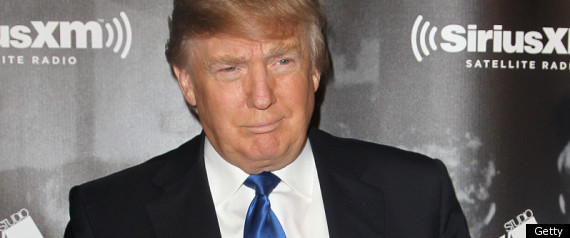
LAS VEGAS — With his trademark flair for spectacle, Donald Trump endorsed Mitt Romney for president Thursday on the famed Las Vegas strip – just hours after Newt Gingrich's advisers were spreading the word that The Donald would be anointing him instead.

Trump's endorsement seemed likely to affect this Saturday's Nevada caucuses – and the GOP nomination fight in general – about as much as a Sin City breeze disturbs the real estate mogul's legendary hair. But he managed to create a stir of a different sort, at least for a day.
Romney said he was glad to get the support, but he seemed almost bemused to be caught up in the Trumpian drama.

"There are some things you just can't imagine happening. This is one of them," Romney said with a smile, looking out at the reporters and cameras jammed into the lobby of the hotel complex that bears Trump's name. The real estate mogul had entered to applause, with Romney and his wife, Ann, at his side

"Mitt is tough, he's smart, he's sharp and he's not going to allow bad things to continue to happen to this country we all love," Trump said. He vigorously shook Romney's hand and said, "Go out and get `em. You can do it."

But the endorsement was just the finale for a puzzling chain of events that began Wednesday when Trump's office announced he would be flying to Las Vegas for a "major announcement" related to the presidential contest.
Trump had announced last spring he would not run for the Republican nomination but had hinted as recently as last month that he might run for president as an independent.

What would he say in Las Vegas? Gingrich advisers suggested Trump had sent "signals" that he planned endorse the former House speaker. The Gingrich team began leaking word of an impending endorsement to news organizations including The Associated Press.

Nope. Reporters learned Thursday that Trump would be endorsing Romney instead.
Earlier, on a tour of a Las Vegas manufacturing facility, Gingrich made clear he had gotten the message.

"No," the former House speaker replied when asked if he was expecting Trump's endorsement. He added that he was amazed at the attention Trump was getting.
Romney hasn't always been Trump's man.

In an interview with CNN last April, Trump dismissed Romney as a "small business guy" and suggested Bain Capital, the venture capital firm where Romney made his millions, had bankrupted companies and destroyed jobs.

"He'd buy companies, he'd close companies, he'd get rid of jobs," Trump said.
Romney, for his part, turned down an invitation to participate in a presidential debate that Trump planned to moderate in Iowa in December, leading Trump to cancel the event
. And while Romney, like most of the GOP hopefuls, visited Trump at his office in Manhattan to discuss campaign strategy, he slipped in and out of the building without speaking to reporters.

Trump has played an unusually prominent role in the presidential contest since last spring, when he mused publicly about joining the Republican field.

He also stirred controversy and considerable criticism during that time by openly questioning the validity of President Barack Obama's birth certificate, lending credence to the chorus of "birthers" who say Obama was not born in the United States and not eligible to be president. The fuss pushed Obama to release a long-form version of his birth certificate, showing he was born in Hawaii in 1961.

The president dismissed Trump as a "carnival barker" and then memorably skewered him at the White House Correspondents' Association dinner in Washington, which Trump attended.

On Thursday, Romney said he was honored to receive the endorsement, but hoped even more to win the support of Nevada voters. The state holds presidential caucuses Saturday.

Trump, for his part, called Gingrich "a wonderful person" but said he had decided to endorse Romney two weeks ago.

"He's a friend of mine, I like him a lot. I respect him a lot. But this is the way I went," Trump said.
Trump said China policy was a key factor in his decision to back Romney.

Trump has often accused China of manipulating its currency and "cheating" the U.S. – a theme Romney has echoed on the campaign trail.

At a later event, Romney criticized the Obama administration on a different point of foreign policy – the possibility of releasing several inmates from the U.S. prison at Guantanamo Bay, Cuba, as an incentive for the Taliban to join peace talks.

"A sign of good faith? Are you kidding me? A sign of good faith to our enemy?" Romney said.
Trump, a multimillionaire and host of a reality show where he famously proclaims "You're fired," said he wasn't worried that his endorsement would hurt Romney, another wealthy businessman whose opponents have criticized as out-of touch.

"I really think he does connect, and he's starting to connect really well," Trump said.
Democrats, for their part, signaled they believe Trump's endorsement of Romney could work against him. The campaign sent out video of the endorsement event on the president's Twitter feed, with no added comment.

Rival candidate Rick Santorum said of the Trump endorsement, with no small amount of sarcasm: "I can't imagine Donald Trump being hypocritical. That would be totally out of character for Donald Trump."

Santorum added: "You know, Donald Trump does things for one reason and we all know what that reason is. And I think people the people of Nevada are smart enough to figure out who they're going to vote for. It's not going to be based on what Donald Trump recommends."
___
Associated Press writers Kasie Hunt, Shannon McCaffrey and Philip Elliott contributed to this report.